
Why Connection Is Driving Retail Design Performance

Updated: Apr 30
Writer: Bridget Taylor
Retail sales aren’t happening where you think they are.
They’re happening in moments of connection.
Recently, I was at a Platter & Natter event hosted by the Retail Interiors Association and held at the beautiful CASABELLA. It was a relaxed evening of networking, headlined by Martin Skinner recalling his experience at the Malls & Stores of the Future Summit.
Between his fascinating talk and conversations with my peers, one theme kept coming up: connection.
We all need a sense of community and belonging, and in design, connection refers to not just how a space looks, but how it feels to be in.
That night, many people I spoke to mentioned a shift in retail where the in-store experience is becoming more important than the immediate purchase itself. It’s less about closing the sale on the spot and more about how customers feel in the space, with purchases often happening later, online.
That is a big shift for retail design. For years, success was measured at the counter. Now, it is just as much about what people remember.

If you think about it, retail has always been about experience
To me, growing up in the 90s in small town New Zealand, places like Deka were a retail outing.
At its peak, Deka was one of the country’s largest department store chains, sitting at the centre of many small town high streets. It was where people went, not just to shop, but to connect.
You would look forward to it. (At least, I would!)
You would wander.
You would run into people you knew.
It wasn’t just about what you bought: it was about being there.
As large local retailers and global brands expanded, many of these smaller, community-centred stores disappeared. Luckily, what they offered - that sense of familiarity, ease, and human interaction - did not. The bigger box stores put more effort into replicating this sense of place that we are all drawn to.
Now retail is everywhere. Even in our pockets. You no longer need to go shopping - but many of us still choose to go. And so, the role of physical space has shifted even more towards experience over sales.

The rise of digital and AI in retail design
At the same time, we are seeing a huge rise in digital integration.
Self-ordering kiosks. AI-generated concepts. Automation designed for speed and efficiency.
And there is real value in that.
AI is changing how early-stage design happens. Clients are arriving with ideas that are fast, visual, and emotionally driven.
But AI also skips a layer. Because those concepts are often not grounded in real materials, lighting, services, compliance, or budget.
Where AI meets human connection in retail design
Last month, we worked on a project in Dunedin’s Meridian Mall that really put AI to the test.
The brief: a kiosk space big enough for two small retailers, positioned near a Toyworld and CityFitness. High foot traffic, but limited space, so visibility and circulation were tight.
We worked with our client who saw an opportunity to activate the zone just outside these large retailers. We came up with a plan for two kiosks, side by side. One for convenience snacks or drinks, the other is an embroidery shop. Perfect for the gym-goers and busy parents frequenting the neighbouring shops!
We tested the space with and without 3Ds, using just the site photo and then with accurate layouts and 3D proportions within realistic constraints.
Not every AI output worked. Some missed the mark completely.
AI would relocate the kiosk to odd places. It changed the proportions of our space.
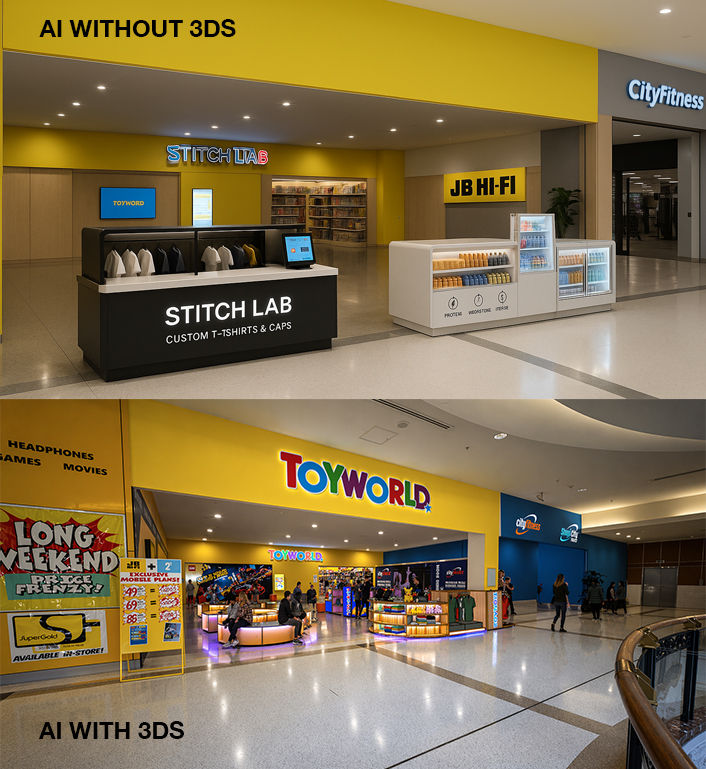
AI is a powerful tool, but it doesn’t understand space the way a designer does. It can’t judge how far back something should sit, what sightlines need to be protected, or how much room to leave so a space still flows.
It’s never had the experience of shifting in a seat, so it’s no surprise that it doesn’t nail the nuances of seating. It doesn’t appreciate how giving people a reason to pause, even briefly, can completely change how they engage with the space.
AI can help us test and visualise ideas faster. But it’s not building from the ground up. That’s great for playful impressions and quick concepts, but it’s the designer’s role to shape them into something that actually performs in the real world.
AI can explore. But design decides.

What would a space look like if it were designed around connection, not the counter?
The other day, I was in a space with large self-ordering screens. Everything worked. It was efficient. But no one spoke.
My son, who could barely see the POS machine, was searching for that interaction. I could see him looking for someone to make eye contact with. Someone to guide him through the experience.
It felt seamless, but also disconnected.
That is the tension. That is the trade-off we get when we rely too heavily on AI.
While digital tools improve efficiency, they can remove the very thing that makes a space memorable. The human layer.
Designing for connection is not just about how the interior space functions. It influences how people move, how long they stay, and how a tenancy performs over time.

Looking ahead
The goal is not to remove digital, but to balance it with a human touch. To use tools like AI and automation where they add value, while still designing spaces that create genuine connection.
Because in retail today, if people don’t feel something, they won’t remember you. And if they don’t remember you, they won’t come back.
That’s the shift.
Retail isn’t just about what you sell anymore. It’s about what people remember.
So, what will they remember about your space?
Bridge x x


The text is well structured and addresses the topic with the right depth. The author demonstrates a good knowledge of the subject. I appreciated being able to find all the necessary information in a single text. Usually it is not simple to find information so well organised on this topic.
This text addresses the topic in a thorough and detailed manner. I appreciated the completeness with which the various aspects are treated. I shared this content with some people in my field. It is a text that provides a clear and well-organised view of the topic.
This article raises vital points about how retail has transformed over time, especially with the integration of technology. It made me reflect on the importance of creating emotional connections in spaces where people shop. The mention of Leon resonates with me, as it showcases how food and experience intertwine, enhancing customer engagement. Balancing AI’s efficiency with genuine human connection is crucial for memorable experiences.